In conversation with Juliet Rosenfeld: ethics, candour & changing tides
"For me, the beauty of psychoanalysis is that it is such a radical way of thinking about the mind."
In January of this year, the BPC hosted a CPD event on the importance of the Duty of Candour. For the event, psychoanalyst Allessandra Lemma summarised the importance of professional candour, based on her work First Principles: Applied Ethics for Psychoanalytic Practice. Joining her for a discussion on the considerations raised, was psychoanalyst Juliet Rosenfeld who has recently published her second book Affairs: True Stories of Love, Lies, Hope and Desire.
We caught up with Juliet after the event to discuss these themes further, and to talk about her book as well as her ongoing PhD research.
Niamh: Your discussion with Alessandra Lemma on Duty of Candor covered fascinating aspects and friction points around psychoanalysis and ethics. One friction point that Alessandra highlighted was the application of ‘value judgements’ or ‘normative assumptions’ in response to your question about changing lifestyles and attitudes throughout history. You noted that psychoanalysis can be “slow to see change”. Your book Affairs: True Stories of Love, Lies, Hope and Desire felt like, in part, an attempt to look at ‘the affair’ from an observant perspective rather than a judgemental one. Why is it important to you to work psychoanalytically through this lens?
Juliet: I think that in the last 25-30 years, the changes which women have been undergoing are seismic. The factors driving that are the subject of my PhD research. Women are better educated now than men from primary school to degree level and I think that there are obvious consequences of that. These factors are economic, professional, they involve autonomy and choice. We know that marriage is declining. We also know we’ve got the lowest rate of childbirth ever. I think all these factors are relevant to what we see in the consulting room and I think that it’s related to the point that Alessandra raises so beautifully in her book, around analysts knowing what is right for the patient. This idea that there is one journey that a woman goes on with a heteronormative, long-term, monogamous relationship and children is, I think, no longer accurate. Technology means that you don’t need to be in a couple to have children. Same sex relationships have increased in the last 30 years. I think all of these things are relevant to psychoanalysis. They are external events in someone’s life, but they’re also key to how someone feels. I think what Alessandra is raising in her book First Principles is around how we need to think about the choices someone makes, which are very different to the choices made when psychoanalysis was invented. Of course, there’s a long history of writing around how women and feminism fit in psychoanalysis. So, I think this point about ethics and about an absence of judgement feels key.
For me, the beauty of psychoanalysis is that it is such a radical way of thinking about the mind. The unconscious is not a place where there are laws or political correctness. It’s for anyone that’s had a woken up from a dream and thought: “My goodness, where did that come from?” The substantial difference between psychoanalysis and anything else is this radical use of the unconscious to help us understand things. At the same time, I think that in the consulting room, for example, we have to be mindful of the language we use and understand what that might mean to a patient because the unconscious can be lawless. I think that’s one of the reasons why I’m very interested in what Alessandra has written about.
Niamh: It feels like there’s been a lot of cultural signifiers recently, of this collision between expectations of women and societal attitudes. For example, the recent Vogue article entitled ‘Is Having a Boyfriend Embarrassing Now?’ sparked a surprising amount of debate. How does psychoanalytic thinking fit into this? How do you navigate these competing notions?
Juliet: I think you would get as many different answers depending on how many psychoanalysts you asked. There might be a doctrinal way of believing that everything that happens in the consulting room is only transferential. To me, that doesn’t feel possible. I think that taking notice of external reality is important because there is a changing external reality. There is so much written about this world where women, financially for example, don’t need men to function. So, I think that does need to be reflected and thought about.
Psychoanalysis has a complicated history with feminism. Psychoanalysis was begun by a man and the first psychoanalysts were men. It remains a profession where men are still often at the top. It’s a profession where there are inequalities and the fact that the women are better educated than men doesn’t mean that, for example, there isn’t a pay gap or that there aren’t opportunities being missed due to things like maternity leave or other reasons we don’t know about. I think this this is all part of something that psychoanalysis needs to think about and take seriously.
Niamh: Your discussion with Alessandra raised a range of ways the therapeutic relationship can go wrong, including boundary violations. One of the affairs described in your book is a boundary violation that occurs between a therapist and a patient in the US. You reflect you quite honestly about your perspective of this as a practitioner. Was it important for you to look at a case like this? Was there anything unexpected you learned?
Juliet: Well, my book is not an academic book, I followed no academic protocol. I put adverts on websites and in publications inviting people to write to me. I was very sceptical about whether anyone would reply but my inbox started to fill up. So, I didn’t choose that story, a woman volunteered it. I was interested in it because I’m a psychotherapist but in the end, I really came to believe that it was a story for anyone that’s interested in psychotherapy.
A big problem in psychotherapy is the gravest violation: when a therapist has a sexual relationship or encounter with a patient. I thought it was important to write about it. Unfortunately, these cases are not as rare as we might hope. This was different in the sense it was a woman therapist, so rarer still. But I suppose I thought that it offered an opportunity to think about the level of trust and responsibility that we have as practitioners, to look after ourselves and to ensure that that we’re not vulnerable to such violations. I think, going back to ethics, one of the things that is critical to think about is our vulnerability when we don’t take supervision seriously and don’t use it properly. I felt it was important to try and explain that.
Niamh: In your discussion with Alessandra, you talk about the fact that things going wrong in the consulting room is something that’s not widely written about. It would be interesting to hear more on why you think the literature is so rare or why that type of reflection is so difficult as a practitioner?
Juliet: The obvious answer is that it doesn’t put the writer into a very good light, does it? Yet it’s really important. Aside from my academic work, I’m writing for anyone that’s interested in psychotherapy. You may not be able to afford psychotherapy, you may not have access to it but most people can get hold of a book in a library. So, I think that those of us who want to write for a non-clinical audience should be able to. I think that one of the problems about writing is that psychoanalysts feel often that they will be judged negatively by their peers.
I think there is a whole other conversation around how we write about patients, which I hope that BPC will do some thinking around. This is a subject that really occupies me. How do we write about patients in an online age? This wasn’t a problem that faced Freud or Winnicott but it’s something we face now. How can we write confidentially? But the problem with not writing about our patients is that it’s difficult to explain what we do otherwise. Freud began with his case studies, and I think this is an area where we need to continue to work. For example, people like me who are writing in an applied sense, the reason I chose to put adverts out to talk to people was because I felt strongly that I didn’t want to write about my patients in this context.
I think it is a growing issue. I think that there can be a snobbery about people who are writing for the general public and not learned journals. I am very interested in how you use ordinary language to explain what goes on in the consulting room. I think it’s important for us to encourage people to write in different ways about the work, because it’s how we learn. I think psychoanalysts do feel anxious about writing. Once you have written about a patient, I do think something is inexorably changed about the relationship with that patient. We haven’t got a solution to that.
Niamh: Affairs felt like an accessibly written book that gave valuable insight into your thought process as a practitioner. How did you learn to write in that way? I’m also thinking about the public, press roll-outs for books like yours, you’ve made appearances on various radio shows and podcasts. There’s a lot to balance there, I’d love to know a bit more about how you navigate that.
Juliet: I’m like a lot of people in that I’ve always wanted to write a novel and never managed. I’ve written two non-fiction books but with both, the idea came to me and I was off. I wasn’t taught to write but I’m an avid reader and I originally trained as a linguist. So, perhaps those things made me think I could write something.
These are controversial issues in psychoanalysis because you will still have analysts who believe that anything but their name and a landline is all that the patients should have but we live in an age now where people are used to gathering information. I think I knew I had to concede that if I’m going to write books like this, there’s a bit of information about me which a patient can access. You have to make some kind of agreement with yourself about that.
There’s also narcissism in writing anything, isn’t there? At some level I gave into that because I wanted to write a book and you do need to publicise books, non-fiction is a dense market. But I think I’m driven, I came from a non-medical background into psychoanalysis. I was in communications for 20 years, ending up in government communications. I’m interested in regulation and how we broaden access. I’m on the board of the Freud Museum, which is a wonderful place that we’re fortunate to have in London. We promote ideas about mental health and the unconscious. I think these things are part of what I’m interested in.
If I was going to be a friendly critic of psychoanalysis I think there’s an ivory tower aspect to it. I think that psychoanalysis should appear more in policy. It seems wrong that more people aren’t offered high-intensity treatments on the NHS. Of course, it’s always about what’s affordable. But I think we should be finding ways to promote psychoanalysis as much as possible. Psychoanalysis shouldn’t be something that is only for certain people to understand. We should be talking about it in ordinary language and not over complicating it. They are complicated ideas, but they’re also just about human beings.
Niamh: Both your book and your discussion with Alessandra communicate, in their own way, the fallibility of being human, that the consulting room is a place for both the analyst and the patient to grow and learn. Is it important for you as a practitioner and a writer, to learn and grow from your mistakes? How do you think the profession moves forward in the transparency and honesty that you both held at the at the CPD event?
Juliet: I think what BPC is doing this year and beyond is really important and it will be strengthening. Most psychoanalysts work alone. It’s a very solitary profession. I think that if we can think about ethics together with peers and in groups, with our supervisors, it’s very liberating because instead of it becoming attacking and feeling terrible at your job, it allows you to think instead about what you should be doing. We are all trained to be aware but I think it gives you a quick reminder that we do all make, in quotation marks, “mistakes” but if we can understand the reasons for them and, at appropriate times, apologise for them, in a way that has an impact on the patient, then there’s great value in that.
I have come to the view that we should teach ethics as part of our requirements, because it’s just so interesting. Ethics goes back much further than psychoanalysis. So, how do we make a psychoanalytic ethical framework? The one that Alessandra uses is borrowed from medicine, which is logical, but what more can we do to make it our own? That seems to me to be a valuable thing to think about.
I think it that brings us full circle back to the selection of patients that we write about. How do we write about them and our own ethical feelings? How do we consider them deeply? As I said at the beginning of my book, there is a lifelong agreement about privacy that you’re making with your patients. This is an important ethical commitment. We need to think about how and when we break that commitment in service of something important. I think there’s a lot of work that needs to be developed around that.
Something that came up in the event was thinking about hierarchical structures and institutions. We value experience, we value age. But we also have to be really careful that those components don’t mean that things become set in stone. Particularly when there is a problem. In the outside world this happens all the time, one might call it chemistry. For example, when you just don’t get on with your manager. In these cases, there’s a whole process that you follow if you work in an office or company. In psychoanalysis, we have these very particular committees and ways in which institutions organise themselves. It’s important that ethics are taken seriously, not just through these committees, but also in how these institutions are run.
To attend future BPC CPD Events, visit our events page.

Affairs: True Stories of Love, Lies, Hope and Desire by Juliet Rosenfeld
Purchase Affairs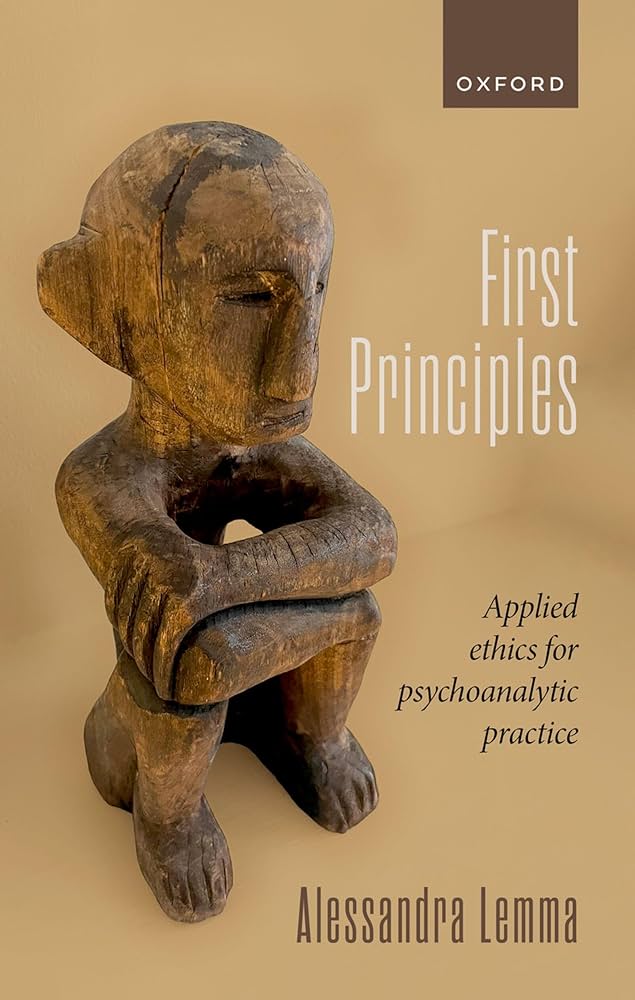
First Principles: Applied Ethics for Psychoanalytic Practice by Alessandra Lemma
Purchase First Principles